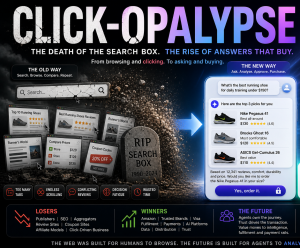
Death of the Search Box and the Scroll Economy
Before: Consumer purchase journey = search → browse 15+ tabs → compare → decide. Links were the unit of economic value. Google CPC, SEO, affiliate commissions, programmatic ads all monetised the long browse.
After: Bot-mediated journey = ask → shortlist → approve. One conversation replaces ten pageviews. Links — and the businesses built on them — are going extinct.
Where we are now. Just like web, the bot route has its own maturity curve, currently transitioning from “trusted for recommendations” to “trusted to route purchases.”
How Bot Time Is Savaging Scrolls and Clicks
Every minute spent in a bot conversation is a minute not spent scrolling, clicking, or generating ad impressions. The arithmetic is brutal.
Time displaced. ChatGPT alone runs ~1B messages/day with several hundred million weekly users by late 2025. Average session length is rising — it comes directly out of Google search sessions, review-site browsing, Reddit threads, and Q&A scrolling.
Tab compression. A considered purchase used to drive 15–30 tabs across publishers, retailers, and forums.Bot journeys collapse this to one conversation citing 3–5 sources users may or may not click. Even when click-through happens, session depth, dwell time, and pages-per-visit all decline. Ad-supported businesses lose on every metric simultaneously.
Click extinction signals.
- Stack Overflow traffic down ~50% from peak
- Publisher referral traffic from search reportedly down 20–40% across major outlets, depending on category
- Reddit and Wikipedia long-tail lookups falling as bots cite-and-summarise rather than send users through
The compounding mechanic. As bots improve, fewer users click, which gives publishers less revenue, which means less new content, which makes the open web thinner, which makes bots more valuable as the synthesis layer. Self-reinforcing.
Where compression is already heaviest: technical Q&A, product research, travel, medical, how-to, comparison shopping
Where it’s coming next: local services, financial product comparison, B2B software discovery
Where it’s resisted: entertainment scrolling (TikTok/Reels), brand/identity shopping, news, gaming, messaging, live sports
The lag from consumer time-shift to revenue impact at affected companies is 12–24 months.
Winners
The companies that get paid regardless of which bot wins.
| Ticker | Role | Rationale |
|---|---|---|
| AMZN | Fulfilment + AWS | Default destination for bot-routed purchases; AWS is picks-and-shovels for the AI build-out |
| V / MA | Payment rails | Survive any discovery layer; bond-like compounders |
| MSFT | Enterprise AI distribution | Copilot in Office/Teams/GitHub; Azure infra. Multi-model strategy (MAI + OpenAI + Anthropic + open-weights) — distribution moat is the asset, not the OpenAI tie |
| GOOGL | Partial / hedged | Bear case needs both Gemini losing AND distribution moat collapsing — low joint probability |
Resilient — Hold
Companies with differentiated supply or entertainment moats that survive the shift.
| Ticker | Why |
|---|---|
| ABNB | Heterogeneous supply, not API-queryable like hotels |
| META | Entertainment, not utility — competes with TikTok, not ChatGPT |
| AAPL | Optionality on on-device AI; toll-collector either way |
| WMT, COST | Quiet beneficiaries on price-sensitive routing |
Losers — For Thesis Completeness
We don’t short. But the thesis is only intact if these businesses are visibly impaired over the horizon. Watching their fundamentals deteriorate is the confirmation signal that the rails trade is working. If these names hold up, the thesis is wrong.
| Ticker / Group | Why they’re losers |
|---|---|
| BKNG, EXPE, TRIP | Information aggregators; thin moat over hotel inventory. Bots query supply directly. TRIP first to break, EXPE next, BKNG most resilient via inventory contracts |
| YELP, TRUST, G2 | Review aggregators — bots resolve information asymmetry directly without sending traffic |
| Programmatic publishers | Ad-supported model collapses with referral traffic; long tail structurally broken |
| SEO tooling, affiliate networks (Semrush, Ahrefs, performance marketing) | TAM shrinks even if companies adapt |
| Chegg, Stack Overflow’s parent | Already destroyed — markers, not trades |
Key Risks
- Timing. Every “death of X” call is ~50% wrong on timing. Lag could be 36–60 months
- Incumbent adaptation. Google has been “disrupted” four times this decade and grown revenue each time
- Bot trust drift. Aggressive monetisation may push users back to manual research for high-stakes buys
- Agentic commerce execution. End-to-end transactions (returns, fraud, customer service) harder than demos suggest
- Regulatory. Antitrust on AI tying could reshape competitive landscape
- Model-layer disintermediation. If frontier model labs (OpenAI, Anthropic) build direct distribution, MSFT’s enterprise moat narrows faster than expected
Bottom Line
Own the rails (V/MA, AMZN), keep the AI infrastructure book (already done). Watch the discovery middlemen as the confirmation signal — if BKNG/TRIP/YELP fundamentals don’t deteriorate over 24–36 months, the thesis is wrong and the rails trade unwinds.